
- Home DeZIM Institut
- Events
- DeZIM-Conference 2026
DeZIM-Conference 2026
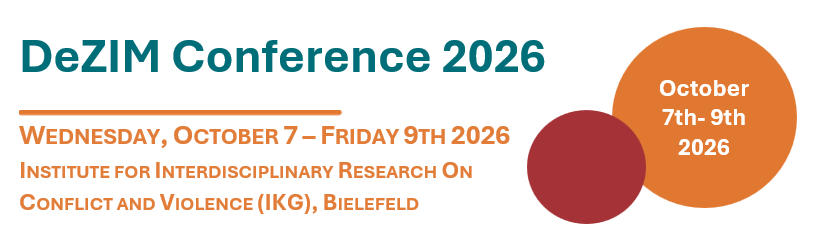
The DeZIM Conference will take place from October 7–9, 2026, at the Institute for Interdisciplinary Conflict and Violence Research (IKG) at Bielefeld University. The application process has now closed, we would like to thank all applicants for their many submissions. Below you will find information on travel and accommodation.
The Contested Normalities of Migration
Migration, displacement, and belonging lie at the heart of social negotiation processes. Yet beyond current polarizations, fundamental questions emerge regarding the drivers and processes of social and political change: How are conflicts concerning migration historically and structurally embedded? In which contexts are migration and diversity an uncontested normality? What are the consequences of “asynchronies,” a coexistence of different intensities and logics of conflict? And along which lines of conflict are the principles of the rule of law being undermined in favor of anti-democratic or illiberal politics?
Taking this approach, the conference aims to examine, from an interdisciplinary perspective, how global crises, transnational interdependencies, national discourses, and local experiences shape long-term shifts in solidarity, exclusion, and democracy. It seeks not merely to interpret conflicts as symptoms of the present, but to analyze them as key dynamics of social transformation and future viability.
Key questions include:
- How do fault lines, narratives, and political orders surrounding migration, flight, and belonging change over longer historical periods? What continuities characterize these fields?
- Which dynamics of closure and openness are evident in political institutions, civil society, the media, and everyday practices, and how can contradictory logics and conflicting tendencies be explained?
- In dealing with migration, what conflict logics - democratizing, stabilizing, exclusive - can be identified in political institutions, civil society, the media, and everyday life?
- How do international conflicts, transnational networks, and local experiences interact and shape longer-term shifts in the understanding of participation, integration, and solidarity?
- How and why do new forms of racism, exclusion, and authoritarianism, and at the same time new practices of solidarity and democratic renewal, emerge in the context of global crises and local conflicts?
- What role do research, politics, and practice play in shaping migration-related areas of conflict, and how can asynchronies in social change be systematically recorded and reflected upon?
The conference is designed to be an interdisciplinary forum for exchange and networking between academia, politics, and practice. Invited participants include academics at all career stages as well as stakeholders from politics, administration, civil society, and practice who work on topics related to migration, integration, racism, and conflict research.
Contact
Any questions can be directed to Esther Beckey and Julia Heinle at tagung(at)dezim-institut.de. Research networking offices at the institutes of the DeZIM research community are also available as contact persons.
Program Committee and Conference Organization
Esther Beckey (DeZIM-Institut), Marcel Berlinghoff (IMIS), Andreas Blätte (InZentIM), Andrea Chagas (MZES), Anastasia Demidova (IAB), Zeynep Demir (IKG), Noa Ha (DeZIM-Institut), Julia Heinle (DeZIM-Institut), Andreas Pott (IMIS), Elias Steinhilper (DeZIM-Institut), Jana Springer (IKG), Andreas Zick (IKG)
