
- Home DeZIM Institut
- News
- DeZIM's expertise in nursing and care
DeZIM's expertise in nursing and care
The German government is currently recruiting new skilled workers from Eastern and Southeastern Europe, Asia, and Africa—including through bilateral migration agreements. Germany will need hundreds of thousands of additional care workers in the coming years, and a significant number of these are already coming from abroad. To this end, the German government plans to establish the “Work-and-Stay Agency.” How can recruitment and placement be made fair and transparent? What challenges do they face, whether because they have left their home country or because they work and live across borders? What support do they receive? What conditions must be created to offer them a genuine prospect of staying?
For in-home care of those in need of care, Eastern and Southeastern European caregivers without recognized nursing qualifications are often relied upon. Their working conditions and paths to Germany are also relevant for the future of the care sector. How do salary and working hours relate to one another? What opportunities do caregivers have to influence their working conditions?
However, the German care system is not based solely on institutional care—a large portion of care is provided by families, often across national borders. What forms of transnational family care exist? To what extent do people in Germany support or care for relatives abroad? What challenges does this pose for those affected?
You can find current publications on these topics from the German Center for Integration and Migration Research (DeZIM) and contact information for academic experts here.
Publications
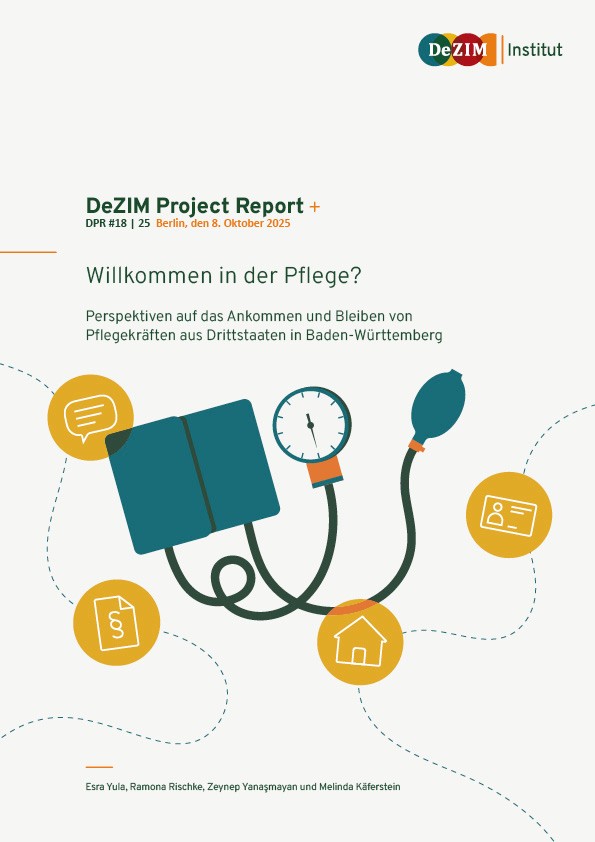
The studies and academic articles shed light on the situation of recruited skilled workers, a topic that has received little attention in previous coverage of the issue. They point out that recruitment without consistent integration structures leads to frustration and encourages emigration. If Germany wants to retain immigrant skilled workers and laborers in the long term, the conditions within the system must change. In addition to the findings, the studies therefore also include recommendations for policy action.



Contact
Dr. Noa K. Ha
Scientific Director, Institute Director
Email: ha(at)dezim-institut.de
Phone: 0049 (0) 30 200754-105 // Assistant: -108
For a long time, Germany was considered an attractive destination—offering secure working conditions, a reliable rule of law, and opportunities for families. But that is changing. Recent studies, including our own, show that many nursing staff are now considering leaving the country. At the same time, competition among Western industrialized nations for skilled workers continues to intensify.Dr. Noa K. Ha, wissenschaftliche Geschäftsführerin DeZIM-Institut

Contact
Dr. Cihan Sinanoğlu
Director of NaDiRa (National Discrimination and Racism Monitor)
Email: sinanoglu(at)dezim-institut.de
Phone: 0049 (0) 30-200754-250
Given the shortage of skilled workers, we will continue to rely on increased recruitment. What is crucial now, however, is to combine this with reliable institutional conditions: a consistent effort to eliminate discrimination and racism in the workplace, transparent recognition procedures, and legal certainty. Only by addressing racial exclusion and discrimination at a structural level can we retain skilled workers in the long term.Dr. Cihan Sinanoğlu, Leitung am NaDiRa

Contact
Dr. Ramona Rischke
Co-Director, Migration Department
Email: rischke(at)dezim-institut.de
Phone: 0049 (0) 30-200754-301
Our study shows that there is a significant degree of indecision regarding the long-term intentions of international nursing staff to remain in Germany. We also observe this marked indecision in other studies, including representative population surveys of immigrants in Germany. Therefore, it will become increasingly important to offer people in Germany prospects that motivate them to stay.Dr. Ramona Rischke, Co-Leiterin der Abteilung Migration

Contact
Dr. Hans Vogt
Research Associate, Department of Integration and National Discrimination and Racism Monitor (NaDiRa)
Email: vogt(at)dezim-institut.de
Phone: 0049 (0) 30-200754-253
As part of the National Discrimination and Racism Monitor (NaDiRa), we conducted research on the situation of internationally recruited nursing staff. The findings show that the health, professional development, and life trajectories of the individuals concerned—and thus nursing care itself—can be significantly impaired by racial discrimination. In particular, this involves the interplay of everyday racism among colleagues and structural injustices that systematically create precariousness, for example by linking residency permits to employment contracts.Dr. Hans Vogt, wissenschaftlicher Mitarbeiter am NaDiRa

Contact
Prof. Dr. Magdalena Nowicka
Head of the Integration Department
Email: nowicka(at)dezim-institut.de
Phone: 0049 (0) 30-200754-200
When institutional care is not necessary or desired, caregivers from Eastern Europe often assist families in Germany in caring for elderly relatives. To date, this sector has largely escaped regulation—to ensure high-quality care, incentives must be created for placement agencies to set and uphold standards.Prof. Dr. Magdalena Nowicka, Leiterin der Abteilung Integration
Events hosted by the DeZIM Institute on the topic of care
Recruited nursing professionals were also the focus of two DeZIM events in 2025, which featured panelists from the nursing sector, politics, labor unions, consulting firms, and civil society. Topics included fair recruitment and social, structural, and institutional conditions upon arrival.
DeZIM_talk: Living and working conditions of internationally recruited nursing staff

Press Contact
Angie Pohlers
Press Officer
Email: pohlers(at)dezim-institut.de
Phone: +49 (0)30 2007 54 130